

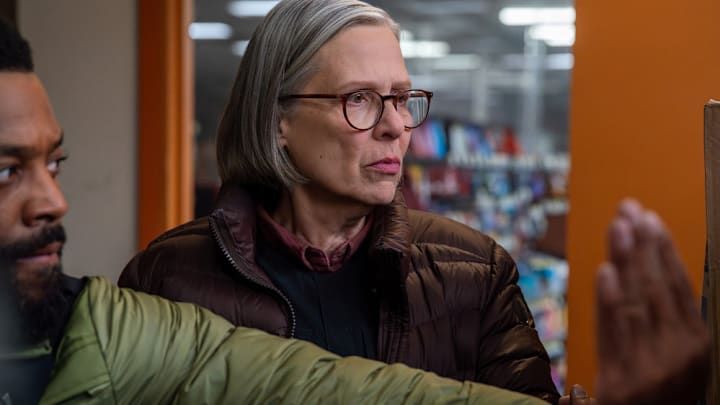
There’s no doubt that Chicago PD has ripped our heartstrings on more than one occasion. We’ve had to face some major losses, but Chicago PD season 13 episode 9 tops them all. This wasn’t because of who died, but because of the nature of the entire episode.
Caution: This post contains SPOILERS from Chicago PD season 13 episode 9.
We were promised a Trudy Platt-centric episode, and that’s certainly what we got. After checking in on her former recruit, McKay, she found him dead, with what she believed was a murder that was staged as a suicide. She couldn’t allow herself to believe that McKay would take his own life, and so, she went on a mission to prove that it was murder.
Sure enough, it seemed like the gang could have been involved. They were at McKay’s house and they did steal his phone, but they didn’t kill him. Burgess found the phone, leading to the realization that McKay had taken his own life, and Rodriguez and his crew got in there afterward and moved the body to find his phone.

Chicago PD highlights a very real issue in the world
While there is certainly a lot of love for Trudy in the episode, it’s not just Amy Morton’s performance that makes this the most heartbreaking episode of Chicago PD. It’s the topic of conversation, a very real issue that people just don’t want to talk about: cop suicide.
NBC Insider spoke with Morton about the series, who shared that “the statistics of suicide in Chicago for cops is the highest in the nation.” It became an important story to tell to get the word out, because something needs to change.
It also turns out that PD producer Brian Luce has a real-life connection to the storyline, as he has lived it himself. After a colleague took his life, Luce was in denial for the longest time. He didn’t see it coming, and he wanted to believe that there was something else to the death. Luce was on set throughout the episode, sharing his own experience, as hard as that would be.
TV shows aren’t just made for entertainment. They’re made to tell real stories, and sometimes, those stories are downright heartbreaking. By bringing them up, though, it allows for people to speak more about it, and it allows cops who are struggling with their mental health know that they are not alone — and they need to talk to someone about it.

Platt’s reaction was human and heartbreaking on Chicago PD
Of course, the fact that Platt was the one to get this focused storyline added to the heartbreak for us. We’ve seen other characters go through losses, and they hurt. However, Platt tends to be at the side, supporting the team when she can and making sure they stay in line.
To have her major episode be one that involved the death of her former recruit added to the layer, as we wanted so desperately to believe that Platt was right and the evidence was wrong. She remained in denial all the way to the end, with only Burgess being able to give her a chance to accept it via the video that she found.
Platt didn’t get angry at Burgess. Instead, she partially blamed herself for not noticing that McKay was struggling all this time. The idea of someone needing help and her not seeing it didn’t sit well with her, and she was in tears over the realization. Burgess was the one to comfort her, as many people who have lived this — whether as a cop or just an everyday civilian — will know that people are good at hiding how they’re really feeling. This wasn’t Platt’s fault. McKay hid it all, and there was little anyone could have done without McKay speaking out.
If you or someone you know is struggling or in crisis, help is available. Call or text 988 or chat at 988lifeline.org. It's free, confidential, and available 24/7.
Chicago PD airs on Wednesdays at 10/9c on NBC and streams the following day on Peacock.
 Add us as a preferred source on Google